
Railways in the North Greater Toronto Area are an interesting mix. One of Canada’s freight railways forms an east-west Toronto bypass, both have lines to get to northern Ontario and western Canada, and both have considerable yards feeding / outletting their networks. In the midst of this are and eastern Canada, with a slight junction in the west and a parallel commuter line in the middle. The rest consists of spurs and yards serving industrial southern industrial areas in Pickering, Ajax and Oshawa, as well as a relatively new commuter rail maintenance facility.
- Halton / York Subdivision
- MacTier Subdivision
- Newmarket Subdivision
- Bala Subdivision
- Uxbridge Subdivision
- Havelock Subdivision
- Notes / Disclaimers
- Explore Railways in Other Cities
Halton / York Subdivision
| Area | 34.4 ha |
| Length | 181.2 km |
| Average Width | 53 m |
| Tracks | 1-2 |
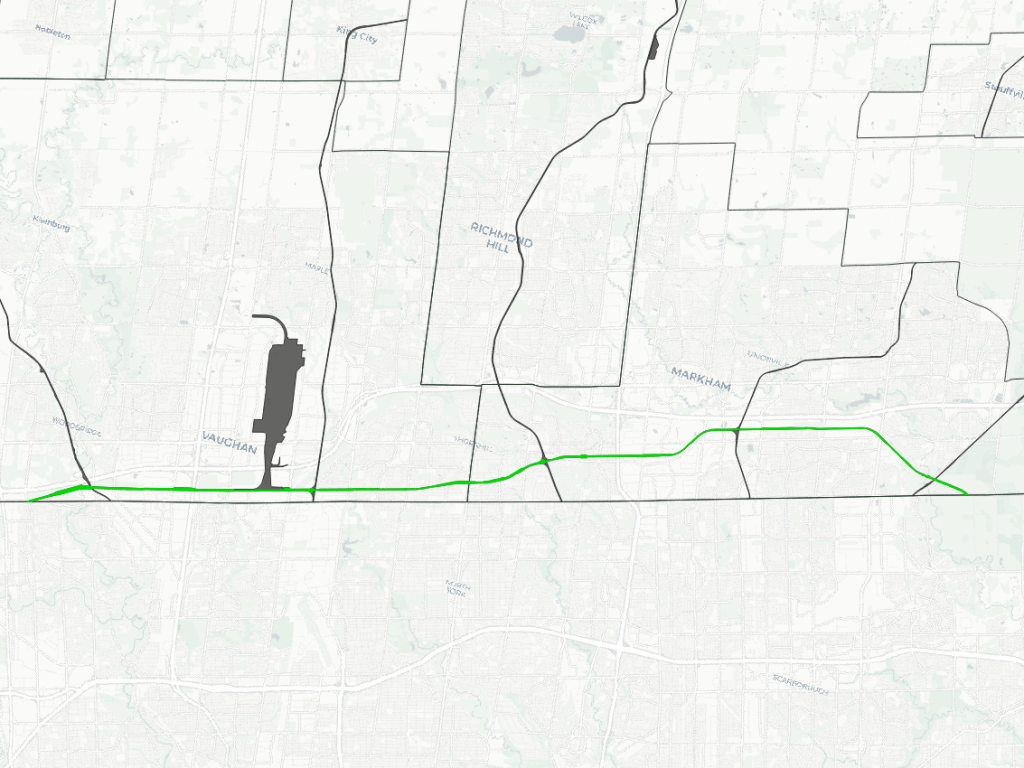
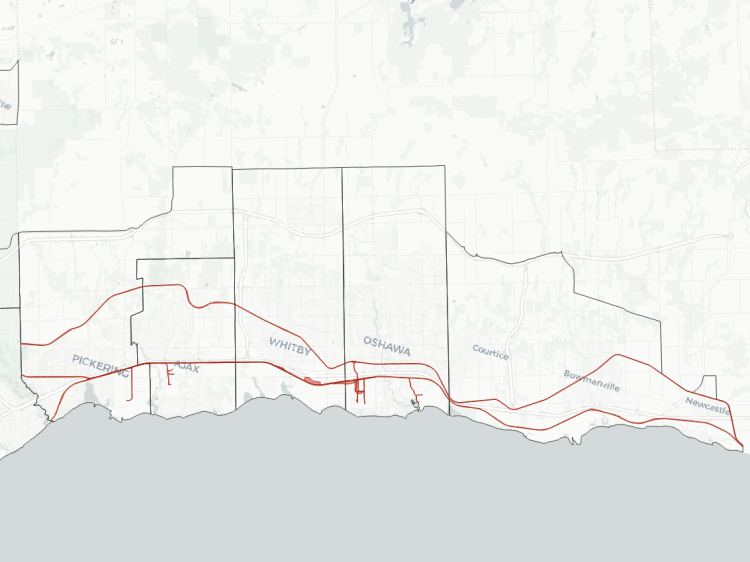
In 1965, CN made a huge shift from routing trains through downtown Toronto, and started using their “bypass” across the bottom of York Region and smaller parts of Halton and Durham Regions. This forms not only part of CN’s east-west spine between ports in Quebec / Atlantic Canada and the US Gulf Coast, but forms the launch pad for a key line to western Canada. It is also the feeder in and out of MacMillan Yard, a major sorting and intermodal yard complex larger than 100 skydomes.
MacTier Subdivision
| Area | 52.2 ha |
| Length | 16.4 km |
| Average Width | 32 m |
| Tracks | 1 |
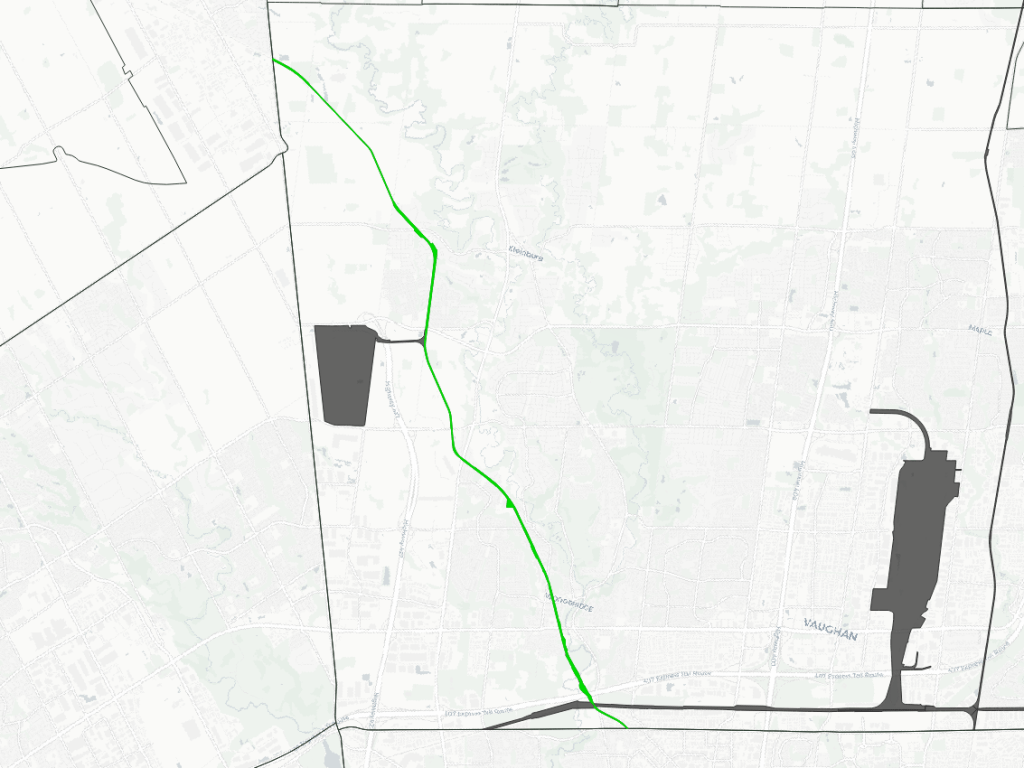
The MacTier Subdivision is the Canadian Pacific Kansas City (CPKC) mainline to and from northern Ontario, and eventually western Canada. It also provides access to its intermodal yard in Vaughan.
Although its predecessor, Canadian Pacific Railway (CP), had completed its coast-to-coast connection in 1888, its original route from Ontario to the west coast was via Chalk River. The MacTier Subdivision was completed 20 years later by building a branch from Sudbury to the former Toronto, Grey and Bruce (TG&B) Railway in Bolton. The TG&B was purchased by CP in 1883, and as it built the MacTier as its new main route to Sudbury, it required substantial upgrades from its original narrow gauge form.
The line still only consists of a single mainline, and does not carry any passenger service.
Newmarket Subdivision
| Area | 105.4 ha |
| Length | 44.8 km |
| Average Width | 24 m |
| Tracks | 1-2 |
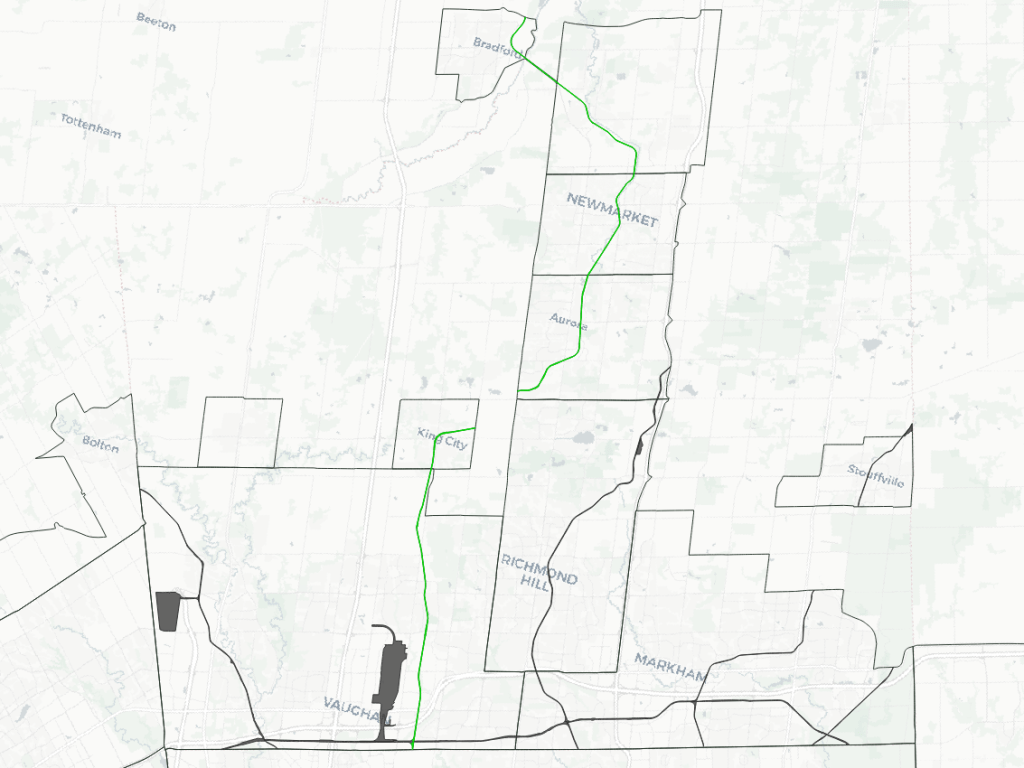
The Newmarket Sub is the modern incarnation of what was Toronto’s first railway. The Ontario, Simcoe & Huron Railway officially opened in 1853. It was subsequently purchased by the Grand Trunk Railway (predecessor to Canadian National Railway) in 1888.
It is now more commonly known as GO Transit’s Barrie Line, which began service in 1982. It runs through the east portion of Vaughan until King City, where it jogs east to serve Aurora, Newmarket and East Gwillimbury. It then goes west again to cross the Holland River and serve Bradford / West Gillimbury, before continuing to Barrie.
CN used the Bala Subdivision for most of its northern and western-bound freight. The Newmarket sub was also used by VIA Rail and the Ontario Northlander for their service north and west until 1996, when segments north of Barrie were ripped up. When CN applied to abandon the line, GO Transit stepped in to purchase the line in segments in 1999, 2002 and 2009.
Bala Subdivision
| Area | 81.5 ha |
| Length | 23.9 km |
| Average Width | 34 |
| Tracks | 2 |
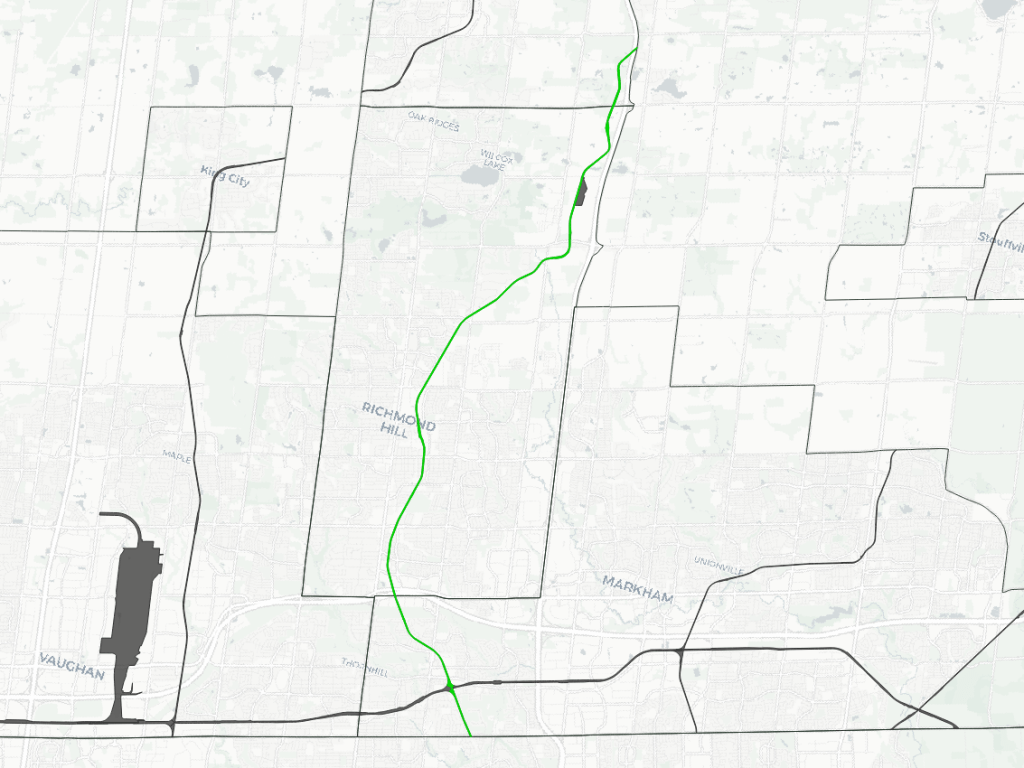
The Bala subdivision was completed in 1906 by the Canadian Northern Ontario Railway. After running into financial trouble during the First World War, the federal government took the railway over and merged it with the Canadian National Railway in 1918.
The Bala Sub is CN’s main route to Northern Ontario. It was also the route into downtown Toronto until the 1965 opening of the Halton and York subdivisions. GO Transit began using the line for train service to Richmond Hill in 1978, and Metrolinx purchasing the segment of the line south of the York sub in 2012.
Uxbridge Subdivision
| Area | 35.5 ha |
| Length | 18.1 km |
| Average Width | 20 m |
| Tracks | 1 |
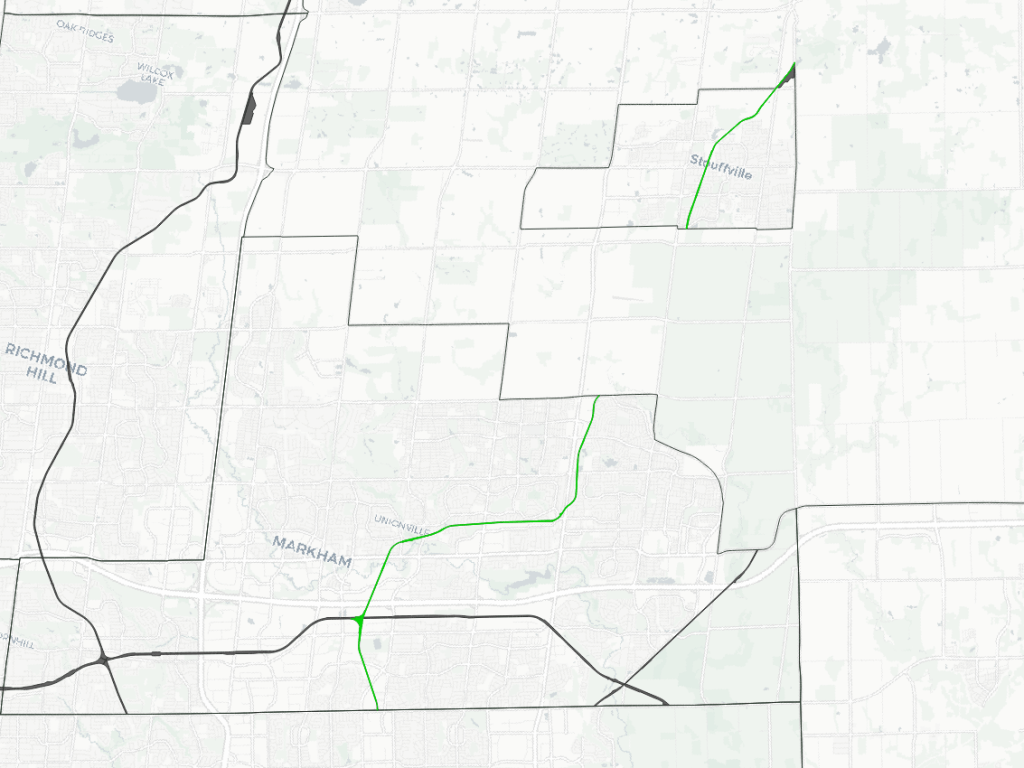
The Uxbridge Subdivision was built by the Toronto and Nipissing Railway in 1871 as a narrow-gauge railway. It was brought under the control of Grand Trunk Railway (via subsidiary Midland Railway of Canada) in 1882, and converted to standard gauge shortly after that.
CN provided passenger service on the line between 1923 and 1973, and that was subsequently taken over by VIA Rail. VIA Rail ceased operations on the line on September 7, 1982, and GO Transit took over passenger service soon after. After purchasing the lien from CN in 2001, GO Transit subsequently constructed four additional stations on the line over the following 8 years.
Havelock Subdivision
| Area | 14.9 ha |
| Length | 6.0 km |
| Average Width | 25 m |
| Tracks | 1 |
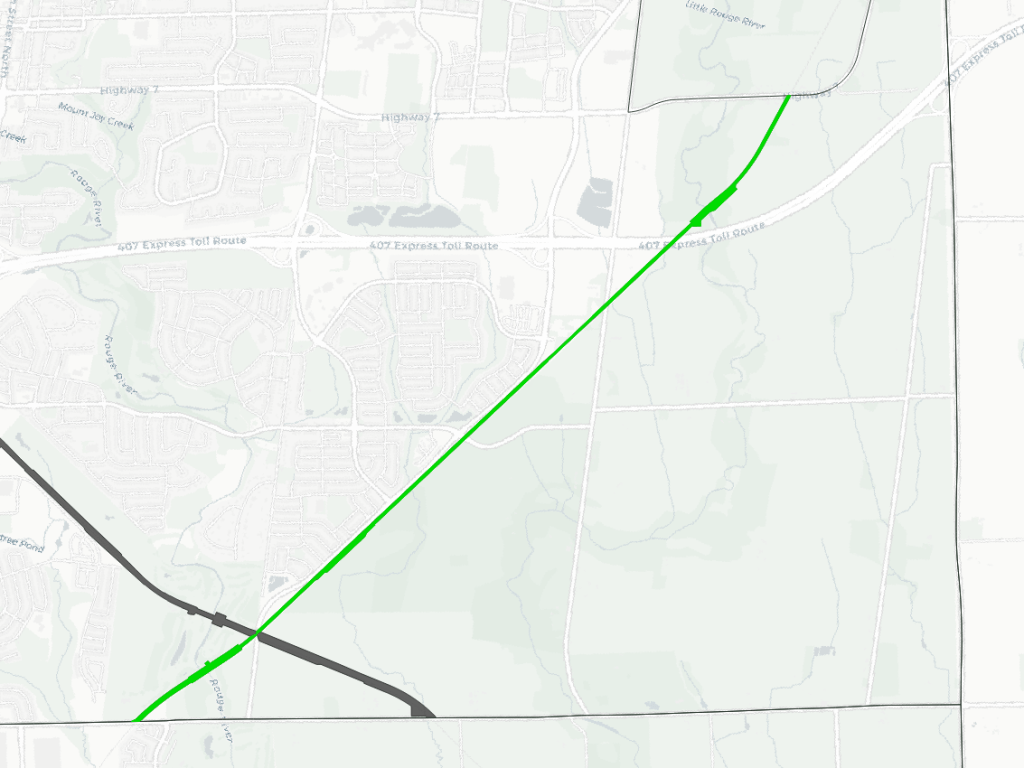
This is a short segment of line which was part of CP’s line to Peterborough. It is no longer used, but will realize new life as part of high speed passenger rail service to Ottawa and Montreal.
Notes / Disclaimers
- This data was drawn interpretively, using the Railway Association of Canada’s Canadian Rail Atlas as a general reference. Some interpretive refinements were made. This data is provided ‘as is’; please refer to additional disclaimers at the Open Data page.
- While this website advocates for greater active transportation access across and parallel to railways, they are private property and are dangerous places. DO NOT trespass on railways; over 100 Canadians are killed or seriously injured trespassing on or crossing railways each year. Remember that train time is anytime.
This dataset is available in multiple formats through the Open Data Portal

 Metroscapes