
Note: This analysis has been completed for a scoped area of interest and not the entire municipal boundary for amalgamated Hamilton. Please see this blog post for more details.
Hamilton is a very interesting city from a watershed perspective. Within most of the urban boundary, it has 5 main watersheds: Spencer, Chedoke, Red Hill, Battlefield and Fifty Creeks. The Spencer and Red Hill watersheds alone cover 144 square kilometres, or 45% of urban Hamilton. The other three make up another 12%.
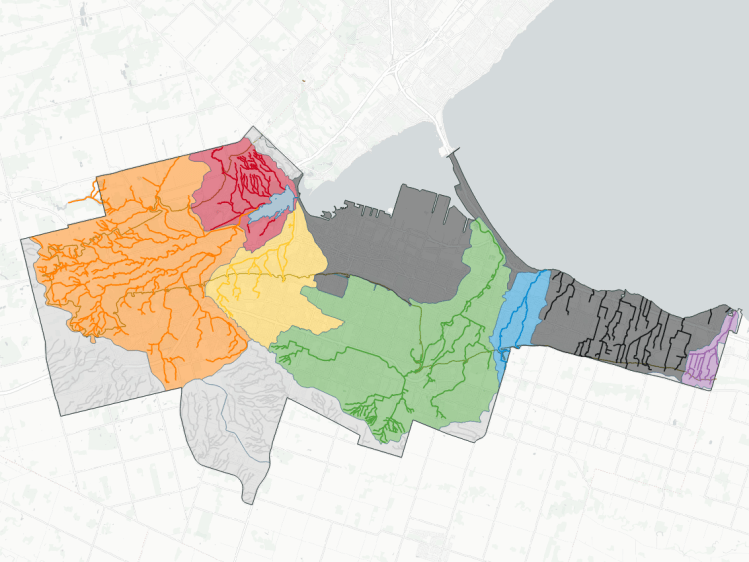
A number of small and medium watercourses covering almost 20 square kilometres drain into Cootes Paradise. Adding the Spencer and Chedoke watersheds that drain into Cootes means that a third of Hamilton’s drainage area flows into Lake Ontario via the Desjardins Canal. The downtown and Stoney Creek areas of Hamilton are served by interstitial drains, covering another 60 square kilometres (20%).
Hamilton’s topography is distinctive in that the Niagara Escarpment runs right through it, and this is a big influence on the city’s drainage. The remaining 55 square kilometres (17%) of the Hamilton urban area has its drainage directed to external watersheds. Some goes to the Grand River, which drains south into Lake Erie, and some goes into the Welland River, Twenty Mile Creek and Forty Mile Creek watersheds that drain east into Lake Ontario within the Niagara region.
The map below shows the boundaries of these watersheds. Overtop of that, I have mapped the numerous watercourses within them, as well as the Niagara Escarpment for reference.
This is a work in progress. See a mapping error? Have a name to put to an unnamed tributary? Please feel free to send me comments.
Notes and Disclaimers
- This data was created with the support of roadway, natural feature, and administrative boundary data various open data portals, made available under the City of Hamilton Open Government Licence v1.1, as well as digital terrain information from the Ontario GeoHub, made available under the Open Government Licence – Ontario Licence v1.0.
- This is interpretive and not based on a full qualified assessment of surface and groundwater resources. Although I cross-referenced with other sources, including storm sewer networks, this may not fully capture or may misinterpret some dynamics. Therefore this data is provided ‘as is’; please refer to additional disclaimers at the Open Data page.
- While this page advocates for greater public access, not all watercourses are publicly accessible. Please observe all signage respecting access and refrain from travelling off established trails, for your health and safety, as well as the integrity of local ecosystems.
Open Data
This dataset is available in multiple formats through the Open Data Portal
Watersheds in Other Cities


 Metroscapes