
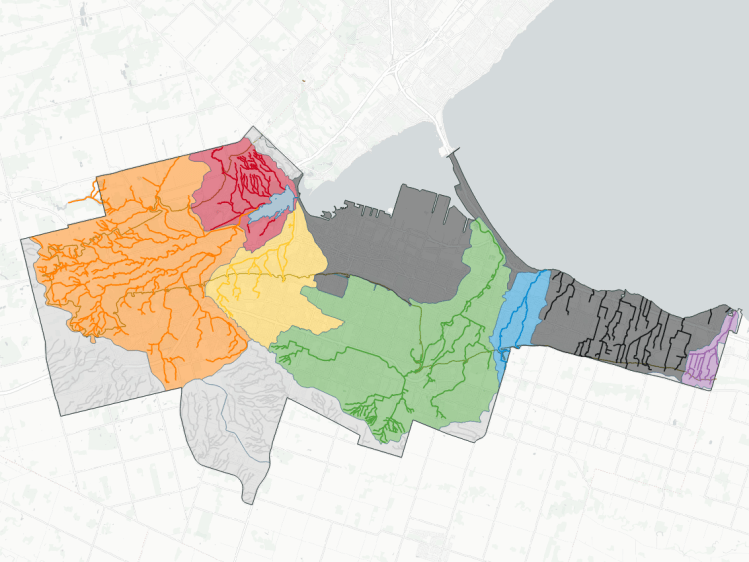
It’s tough to classify watersheds in the West Greater Toronto Area, given the layout of the 1,000 square kilometres within its urban boundaries. The 5 main watersheds are the largest watercourses: Grindstone Creek, Bronte Creek, Sixteen Mile Creek, the Credit River, and Etobicoke Creek. Altogether, they make up 60% of urban Halton and Peel Regions. Grindstone and Bronte only make up 5,000 hectares (less than 5%), though their upstream rural catchments are 4 and 10 times larger, respectively.

The interstitial watercourses make up another 23% of the urban area. Over 30 watercourses, many between 1 and 14 kilometres long, drain these areas. Cooksville, Fourteen Mile, Rambo, Joshua’s, Sheldon, Appleby, Shoreacres, McCraney and Tuck Creeks handle three-quarters of that drainage.
The remaining 190 square kilometres (17%) of the West GTA urban area has its drainage directed to external watersheds. A tiny bit goes to Cootes Paradise along Borer’s Creek, an area equivalent to Grindstone and Bronte put together is the headwaters of Mimico Creek, and the rest is part of the hammerhead-shaped Humber watershed.
The map below shows the boundaries of these watersheds. Overtop of that, I have mapped the numerous watercourses within them.
This is a work in progress. See a mapping error? Have a name to put to an unnamed tributary? Please feel free to send me comments.
Notes and Disclaimers
- This data was created with the support of roadway, natural feature, and administrative boundary data from various open data portals, as well as digital terrain information from the Ontario GeoHub, made available under the Open Government Licence – Ontario Licence v1.0.
- This is interpretive and not based on a full qualified assessment of surface and groundwater resources. Although I cross-referenced with other sources, including Hamilton’s storm sewer network, this may not fully capture or may misinterpret some dynamics. Therefore this data is provided ‘as is’; please refer to additional disclaimers at the Open Data page.
- While this page advocates for greater public access, not all watercourses are publicly accessible. Please observe all signage respecting access and refrain from travelling off established trails, for your health and safety, as well as the integrity of local ecosystems.
Open Data
This dataset is available in multiple formats through the Open Data Portal
Watersheds in Other Cities


 Metroscapes